There are days when my body feels tired before I believe I have done enough to justify being tired.
I may not have completed a strenuous workout or spent the entire day running errands, yet my back feels tight and my shoulders feel heavy. My energy feels low. My body seems to be asking for something I have not given it permission to need.
Rest.
For a long time, I measured exhaustion by what I had physically accomplished. I rarely considered how much energy I had spent thinking, anticipating, planning, remembering, worrying, and emotionally preparing for things that had not even happened.
Lately, I have been thinking more deeply about the connection between my mind and body. I am not trying to diagnose every sensation or turn every moment of discomfort into a profound revelation. I simply want to understand myself more clearly and sharpen the tool of listening to my body, especially after my Multiple Sclerosis diagnosis.
As I have reflected on my tendency to anticipate problems, prepare for worst-case scenarios, and carry responsibility long before it becomes necessary, I have started asking myself a simple question:
What if my body has been carrying what my mind couldn’t put down?
When Responsibility Becomes an Identity
As the oldest daughter, responsibility became second nature to me.
I learned how to notice what needed to be done before someone asked. I learned how to help, how to think ahead, and how to become someone others could depend on.
Those qualities have served me well. They have helped me build a career, care for my family, manage a household, and navigate seasons that required a great deal of strength.
But strength has a cost when it never gets a chance to rest.
For years, I believed carrying everything was simply part of being a responsible adult. It was part of being a wife, a mother, an employee, and the person others could count on.
I did not stop to ask whether being dependable had slowly become an inability to put anything down.

The Work No One Can See
Some forms of exhaustion are easy to recognize. We understand why our bodies are tired after cleaning the house, caring for children, working a long day, or completing a difficult task.
Mental carrying is harder to measure.
It can look like replaying a conversation to determine whether we said something wrong. It can feel like mentally arranging tomorrow before today has ended. It can be checking on everyone else while quietly wondering whether we have forgotten something important.
It is remembering appointments, anticipating reactions, preparing backup plans, and trying to prevent problems before they exist.
The body may appear still while the mind is working several hours ahead.
That kind of work does not always produce something visible. There may be no finished project, cleared room, or completed checklist to prove how much energy was used.
There is only the heaviness that remains.
Living in a Body That Asks Me to Pay Attention

As someone in their 30s living with Multiple Sclerosis, I think about my health differently than I did before my diagnosis. I pay closer attention to my energy, my stress levels, and the different ways my body communicates with me.
I would never claim that stress causes a particular illness or that every physical symptom has an emotional explanation. Our bodies are complex, and medical concerns deserve appropriate medical care.
But I have become more curious about how it feels to live in a body that rarely receives the message that it is safe to soften.
How many years have I spent bracing for what might happen?
How much energy have I used preparing for conversations, outcomes, emergencies, disappointments, and responsibilities that had not yet arrived?
My body may not understand the difference between a problem occurring in front of me and a problem I have repeatedly rehearsed in my mind.
It only knows that I keep asking it to prepare.
Suffering Through Hard Things Twice
During therapy, my therapist brought something to my attention that we went on to explore over the course of several sessions.
I had developed a habit of suffering through difficult things twice.
First, I experienced them in my imagination. I pictured the conversation, the disappointment, the emergency, or the worst possible outcome. I mentally prepared my response and emotionally lived through what I believed might happen.
Then, if the difficult thing actually occurred, I experienced it again in real life.
Sometimes the imagined version never happened at all. Still, my body had already participated in the experience. I had felt the tension, prepared the response, and carried the fear, frustration, grief, or responsibility before life required any of it from me.
No wonder I feel tired.
No wonder rest sometimes feels unfamiliar.
No wonder my body craves softness while my mind continues searching for the next thing to manage.
I used to believe thinking through every possible outcome made me more prepared. In some situations, it probably did. But there is a difference between thoughtful preparation and repeatedly asking myself to emotionally survive a future that may never arrive.
Sometimes what looks like preparation is anxiety holding a clipboard.
When Carrying Feels Like Caring

Putting something down can feel uncomfortable when carrying has become connected to love.
We may believe worrying about someone proves how deeply we care. We may feel that anticipating every need makes us a better mother, partner, daughter, friend, or employee. We might even fear that becoming less vigilant will make us careless.
But caring and carrying are not always the same thing.
I can love someone without absorbing every emotion they experience. I can prepare responsibly without mentally living through every possible disaster. I can be dependable without making myself responsible for outcomes I cannot control.
This is what I hear differently now when I listen to “Bag Lady” by Erykah Badu.
To me the bags she’s singing about represent stress, fear, disappointment, other people’s expectations, unresolved pain, and the anxiety we continue carrying because we have forgotten what it feels like to move without it.
Sometimes we hold on because the weight has become familiar. Sometimes we believe the things we carry prove how much we care, how much we have endured, or how responsible we are.
But carrying everything does not always make us more loving.
Sometimes it simply makes us heavier.
I explored a similar distinction in Responding Without Absorbing, where I wrote about remaining compassionate without taking every emotion and reaction into ourselves. I am beginning to understand that emotional boundaries are not only about what happens during a conversation. They are also about what our minds and bodies continue carrying after the moment has passed.
What Is True Right Now?
These days, I am practicing a different question.
Instead of immediately asking, “What could go wrong?” I am trying to pause and ask:
What is true right now?
Right now, I am safe.
Right now, I am okay.
Right now, I have what I need for this particular moment.
There may still be unresolved responsibilities. There may be difficult decisions ahead. There may be things I cannot predict or control.
But I do not have to live every future moment today.
Tomorrow will ask for tomorrow’s strength. Today only requires today’s.
This does not come naturally to me yet. My mind still wants to jump ahead, create a plan, identify every possible complication, and make sure everyone will be okay.
But now, I am learning to notice when it happens.
I can gently bring myself back without criticizing the part of me that learned to survive by staying prepared.
That part of me deserves compassion too.
Softness Is Not the Absence of Strength
For a long time, I thought healing might require me to become a completely different person.
Someone more relaxed.
Someone who never overthinks.
Someone who moves through life without being affected by everything around her.
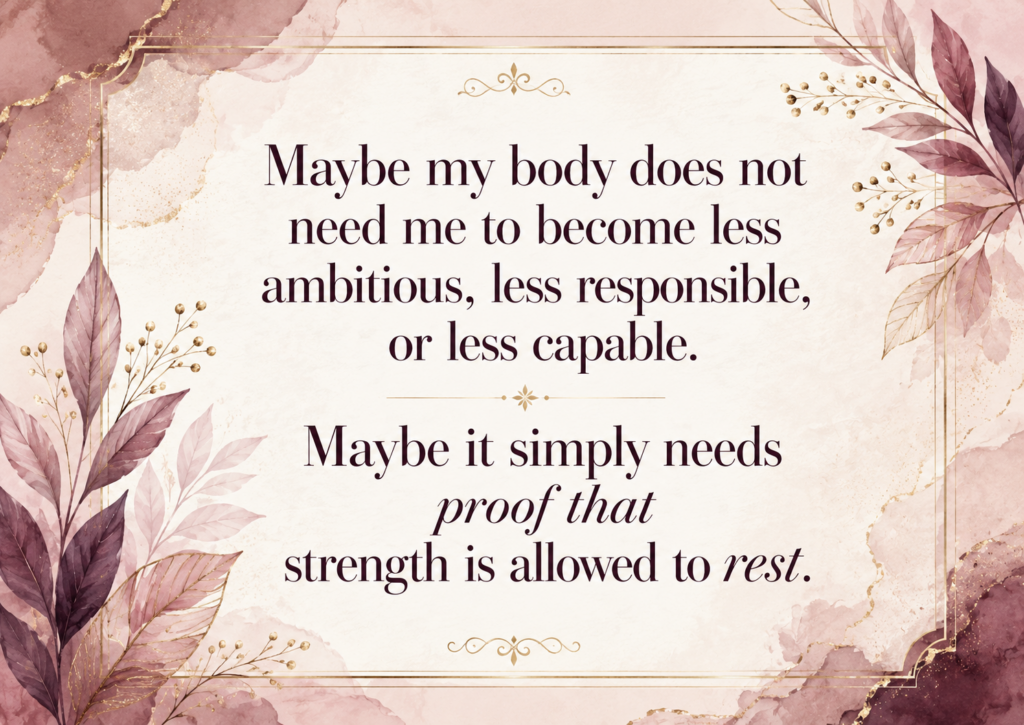
But perhaps healing is not about abandoning the qualities that helped me survive.
Maybe it is about learning when those qualities are no longer needed.
My awareness can remain without becoming hypervigilance. My compassion can remain without becoming emotional absorption. My responsibility can remain without becoming self-abandonment.
And my strength can remain without being activated every hour of every day.
Putting Down What Does Not Belong to Today
Maybe the goal is not to stop caring.
Maybe the goal is to stop carrying what does not belong to this moment.
Perhaps self-care is not always a perfect morning routine, a quiet house, or an uninterrupted afternoon. Sometimes it is noticing the future problem forming in my imagination and deciding not to move into it.
It is allowing an unanswered question to remain unanswered for one evening.
It is trusting that I can respond when more information becomes available.
It is acknowledging that I am tired without forcing myself to prove that I have earned rest.
It is placing one hand on the life I am actually living instead of constantly reaching toward the life I am afraid may happen.
I am still learning how to do this.
I am learning that I do not have to carry every possibility to prove that I am responsible. I do not have to anticipate every painful outcome to prove that I am prepared. I do not have to hold everyone’s emotions inside my own body to prove that I care.
Some things belong to tomorrow.
Some things belong to other people.
Some things belong to God.
And some things were never mine to carry at all.
Today, I am practicing putting them down.
Not forever.
Just for now.
And perhaps, for this moment, that is enough.
Continue Reading
If you are learning how to remain compassionate without carrying every emotion, reaction, or responsibility around you, read Responding Without Absorbing next.
It explores the difference between being present for others and allowing their emotions to become your own.
Join the Her Morning Commute Newsletter
New articles, honest reflections, and gentle encouragement for the seasons in between.
Thank you!
You have successfully joined our subscriber list.